





- We get a 9.2 from more than 3,000 reviews
- Digital dashboard with real-time insights
- ISO certified
Menu

Understanding the impact of prevention on absenteeism, job satisfaction and productivity
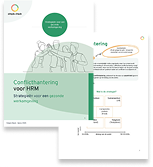
A manual based on proven methods such as TKI, coaching and mediation.

Learn how to effectively use the Sustainable Employability Index to strengthen your organization.


Giving meaning to work prevents work stress: "What are you doing?" asked President John Kennedy in 1962 during a visit to the NASA Space Center to a janitor with a broom in his hand. 'I'm helping to put a man on the moon, mister president,' the man replied proudly. Everyone would see in him a cleaner; he saw himself as part of the NASA Space Team. Thus he gave meaning to his, yet fairly routine work.


5-step plan for effective policy, including checklist.
"*" indicates required fields
More than 1,700 companies went before you. It's that simple. Check.
Every year from Nov. 13 to 16, extra attention is drawn to "stress at work" through work stress week. Some people see this as nonsensical because it does not address the problem at its core, but serves more as symptom relief. That might be true. But you can also use this week to take stock. Actually, it's always a good idea to take stock on a regular basis.
It is interesting to ask yourself whether you are satisfied or dissatisfied with your job. When in doubt, you can find out where that doubt comes from. For example, do you doubt the usefulness of your work? Or do you lack sufficient challenge? These are important questions that play into maintaining the right balance when it comes to stress. Because too much stress is by no means always necessary.
You can give more meaning to your work yourself, and as a result, you will find that you experience less stress. With this, you will regain the enthusiasm you need.
Work is one of the ways people can satisfy their innate psychological needs. For example, we need autonomy (control over our own behavior), competence (sense of accomplishment) and connection with others. Work that meets these needs makes people more motivated, happier, physically fitter, mentally healthier and more productive, according to numerous studies.
Moreover, only then can you become passionate and inspired, making work even a source of happiness. Conversely, work can more often lead to burnout if we have no idea what we are actually doing it for. This is what clinical psychologist Jaap van den Broek experiences daily in his practice: burnt-out people who no longer see the point of their work and have lost themselves. Van den Broek is affiliated with ArbeidsPsychologie Amsterdam (APA).
What type of work feels like meaningful is different for everyone. Some seek it in helping their fellow man (social motivation); others just want to make a lot of money (practical motivation). So it does not necessarily have to be idealistic work: making a popular commercial product can also be very satisfying. Nor does the utility have to be socially responsible. 'You can pack cookies very meaningfully and be meaningless Secretary General of NATO,' says Van den Broek.
Each person will attach importance to different aspects of their work. But the following basic ingredients apply to everyone:
It is possible to give meaning to any job, no matter how boring, by making adjustments on your own initiative that make your task or work environment more challenging and appropriate. This process is called job crafting. Job crafting involves adapting the job content to the employee's knowledge, skills, talents, interests and needs. Anyone can do it, although enterprising optimists who are confident in their own abilities often succeed better than people who are insecure and doubtful.
Anyone who doubts whether their job will still offer sufficient satisfaction five years from now should job craft, believes Wilmar Schaufeli, professor of occupational and organizational psychology at Utrecht University. He says: "Now. Not in five years. By then you may be so jaded and alienated from your job that you lack the energy to make any more changes."
If you do not derive sufficient satisfaction from your current performance, it is possible, for example, to take on new tasks and phase out old ones or fill them out differently (task crafting). Suppose you are a history teacher and love music. Then you can become the conductor of the school orchestra or make lessons more fun for yourself by discussing the nineteenth century using musical excerpts. But even tedious administrative chores might be divisible or delegated. It is important to know what your own talents are, but certainly also to know what the talents of your colleagues are. DISC's method can certainly help with this.
Interestingly, you can also make your job more meaningful to yourself by improving relationships with people at or around your work (relational crafting). You do this by intensifying contact with people you admire or deepening the contact in terms of content (substantive conversations about work, sharing private information, giving support and advice). You can also organize activities, which you will carry out together with colleagues. You can think of an action aimed at a good cause. Or playing sports together.
Finally, you can also change the way you look at your job (cognitive crafting). Seeing it not as a set of separate tasks and activities, but as part of a bigger picture, is one way to change the way you view your job without physically changing anything. As a welfare policy officer, you may have had it a little bit with writing all those municipal memos and plans.
But when you see in practice how well problematic young people are taken care of and when they tell you what it has meant to them, you have a view of the larger purpose of your activities and your part in it becomes more meaningful. Or you can focus on aspects of your work that do give you satisfaction. For example, by keeping the creative aspects in mind: beautiful writing, coming up with new angles. This makes the boring part much less demanding.
By combining these three crafting variations, you create a lot of enthusiasm and satisfaction. This was demonstrated in a University of Michigan study with a group of cleaners at an American hospital. In-depth interviews were conducted with all 28 members of the cleaning crew about the nature of their work. Based on their answers, the group could be divided into proactive and passive cleaners.
The first group did extra chores and sought contact with patients, visitors and hospital staff. The second category did nothing extra and also hardly talked to others. For the proactive cleaners, the cleaning job had much more meaning than for the passive ones. They considered themselves skilled, loved their profession, saw themselves as members of the department and felt that their scrubbing work contributed to the healing of patients. For the passive scrubbers, the same job was meaningless.
You don't have to take a job crafting course to do it. Think about it: most people do it of their own accord to keep their work exciting, otherwise they wouldn't last. But a moment's reflection every now and then on what your contribution is and where you get satisfaction is already very important. And if you can do this, the week of work stress will be a valuable week.
By the way, did you know that Simple Check offers many workshops and coaching programs aimed at increasing personal leadership and focused on discovering your unique talents and motivations. Would you like to know more about this? Feel free to contact us!
Source: Psychology Magazine

As CEO of Simple Check, I am committed to helping organizations and employees work in a vital, healthy, and enjoyable way every day.
Working with Simple Check means clear insight into what is really going on within your organization.
We help companies get a handle on work stress, vitality, health and engagement so that employees stay healthier, more energetic and productive.


A Preventive Medical Examination (PMO) is required by law, but its true value lies in what you do with the results.…
Our consultants are ready to discover together how to create a healthy, safe and vital work environment in your company.
Request a quote Lisa Meddens
CEO of Simple Check
Lisa Meddens
CEO of Simple Check