





- We get a 9.2 from more than 3,000 reviews
- Digital dashboard with real-time insights
- ISO certified
Menu

Understanding the impact of prevention on absenteeism, job satisfaction and productivity
A manual based on proven methods such as TKI, coaching and mediation.

Learn how to effectively use the Sustainable Employability Index to strengthen your organization.


Productivity goes beyond hard work. And in a time of tight labor markets and increasing workloads, it is crucial to approach productivity, therefore, from a sustainable and people-oriented perspective.
It's all about efficiency, focus and the smart use of time and talent. Organizations that structurally improve productivity see better results, less waste and more job satisfaction among employees. Read more about why preventive attention is indispensable and what concrete steps employers can take to structurally strengthen productivity.


Productivity is the degree to which employees create value in relation to the time and resources they use. It is not just about speed, but effectiveness and quality of work. Workplace productivity is a topic that has occupied organizations for decades. It is often seen as a numerical outcome: how much work is done in a given amount of time? But productivity is more than that. It is not only about efficiency and output, but also about the quality of work, the health of employees and their motivation to contribute to organizational goals.
Properly measured and managed, productivity can increase both organizational performance and employee job satisfaction.
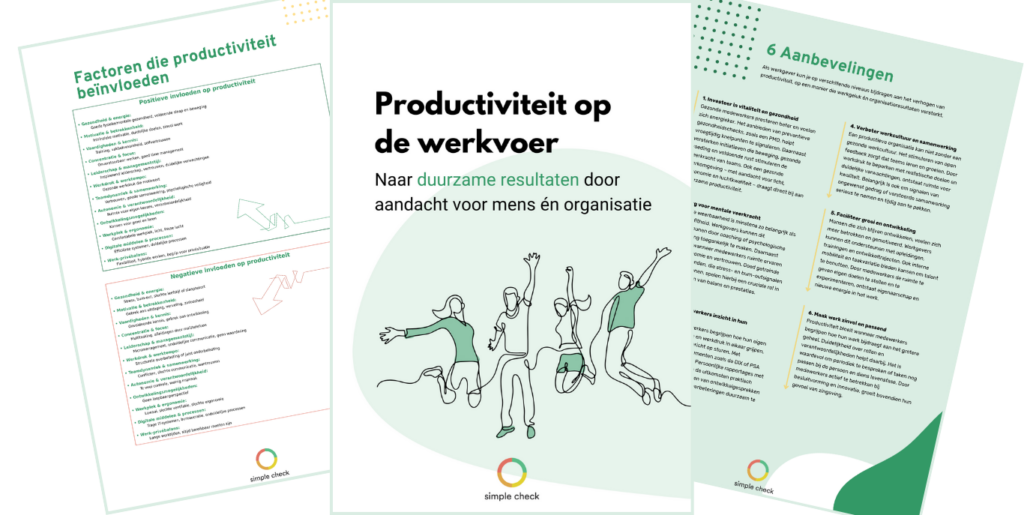
Download our white paper "Productivity in the workplace" on the button below! Together, we make healthy working the norm.
Scientific research (Bakker & Demerouti, 2017) shows that productivity is strongly related to the balance between task demands and energy sources, also known as the Job Demands-Resources (JD-R) model. When workload, complexity or time pressure are too high without sufficient energy sources - such as autonomy, social support or development opportunities - productivity falls and the risk of stress and absenteeism increases.
TNO (2021) confirms this from practical research: organizations that invest in vitality, work culture and preventive health checks not only achieve higher performance, but also have lower turnover and less absenteeism. Productivity is thus not only an economic measure, but also a mirror of the sustainable employability of employees.
Productivity is not just about working harder, but about working smarter. By investing in health, energy and job satisfaction, you prevent absenteeism and increase performance in the workplace. High productivity delivers tangible benefits, such as:
For employees, it means more overview, focus and satisfaction. Productive teams are often more proud of their work and experience more autonomy and ownership.
Productivity can be measured with various tools and methods:
With these insights, you can not only measure, but also make targeted improvements.
Factors that drive productivity include:
As an employer, you can contribute on several levels to increasing your employees' productivity - in a way that is sustainable and contributes to job happiness as well as the organization's bottom line. Here are the most important and effective actions you can take:
Practice shows that organizations that invest preventively in vitality, mental resilience and work culture achieve structurally better results. These are not separate initiatives, but an integral approach in which health, work experience and development come together. Scientific insights confirm that a good balance between energy sources and task demands is directly related to higher performance and less absenteeism.
The employer plays a key role in this. By deploying tools such as the DIX or TNO's PSA, organizations gain clear insight into their employees' perceptions and productivity. That data enables targeted interventions - from preventive health checks to strengthening cooperation and leadership.
The importance of productivity extends beyond just numbers: it's about employees who are healthy, motivated and balanced. Organizations that actively facilitate this reap double the benefits. They see their performance grow, but also build a culture in which people enjoy working and want to continue to develop. Preventive attention to productivity is thus not a luxury, but an investment that guarantees future-proofing.
Want to read more about this topic? Download our white paper here. This white paper offers both scientific insights and practical tools, enabling organizations to not only be productive today, but also prepared for tomorrow's challenges.
Productive employees are people who are healthy, motivated and balanced. As an employer, you can actively facilitate this - not with one isolated intervention, but with an integrated, people-centered approach.
With Simple Check, you actively work toward effective productivity in the workplace. Want to know more?
Contact us for a no-obligation consultation. And find out immediately what we can do for your organization.
Do you want to increase productivity in your organization without compromising energy and job satisfaction? A brief consultation will give you immediate insight into where the opportunities lie.

Make health simple and accessible with Simple Check. Strengthen your organization's vitality together.
 Simple Check gets a 9.3 out of more than 20,000 tests.
Simple Check maps health risks at any location. Our mobile approach makes preventive medical testing accessible, efficient and cost-effective. Simple Check maps health risks at any location. Our mobile approach makes preventive medical testing accessible, efficient and cost-effective.
Simple Check maps health risks at any location. Our mobile approach makes preventive medical testing accessible, efficient and cost-effective. Simple Check maps health risks at any location. Our mobile approach makes preventive medical testing accessible, efficient and cost-effective.
Simple Check maps health risks at any location. Our mobile approach makes preventive medical testing accessible, efficient and cost-effective. Simple Check maps health risks at any location. Our mobile approach makes preventive medical testing accessible, efficient and cost-effective.
