




- We get a 9.2 from more than 3,000 reviews
- Digital dashboard with real-time insights
- ISO certified
Menu

Understanding the impact of prevention on absenteeism, job satisfaction and productivity
A manual based on proven methods such as TKI, coaching and mediation.

Learn how to effectively use the Sustainable Employability Index to strengthen your organization.


Organizations often focus on visible absenteeism: employees who report sick and stay at home. But there is a more subtle and often larger category of absenteeism that receives less attention: gray absenteeism. These are employees who are present but cannot function fully due to mental, physical, or social barriers. Gray absenteeism is invisible in the figures, but very present in everyday working life. It has an impact on productivity and job satisfaction and poses a risk of future absenteeism. In this article, we explore what gray absenteeism exactly entails, how to recognize it, why it is important, and what options organizations have for addressing it.


5-step plan for effective policy, including checklist.
"*" indicates required fields
More than 1,700 companies went before you. It's that simple. Check.
Pink absenteeism occurs when an employee is physically present but, due to certain circumstances, is not functioning at their best. These circumstances can range from stress, mental exhaustion, and physical ailments to work pressure, personal problems, loss of motivation, or insufficient recovery following a previous absence.
Although the employee is present, their effectiveness is often significantly lower. Many employees want to be loyal and continue working, but their capacity falls short. This is precisely why pink absenteeism remains hidden for a long time.
"Pink absenteeism" is now also referred to as "Pink absenteeism." This is because, for many people, the term sounds too vague or too negative. "Pink absenteeism" is perceived as a softer term and is felt to better reflect this subtle, often hidden form of reduced employability.
However, the problem remains the same: employees are not performing at their normal level, even though that is what is expected of them.
Although “pink absenteeism” is not recorded in the same way as sick leave, indirect figures show that it occurs much more frequently. In the Netherlands, approximately 5.2% of workdays are lost due to visible sick leave, and in sectors such as healthcare and social services, that percentage is even around 7%.
But the loss of productivity due to presenteeism—being present but not functioning optimally—is many times greater. Research shows that 76% of employees experience presenteeism. On average, this results in a loss of more than ten working hours per employee every four weeks. The economic damage from this is estimated at over ten billion euros per year for the Netherlands, the majority of which can be attributed to presenteeism.
In addition, approximately 70% of long-term absenteeism has no primary medical cause but stems from psychosocial factors. Common signs such as fatigue, reduced concentration, irritability, declining engagement, or difficulty prioritizing are early indicators of this gray area.
Whereas "pink absenteeism" was difficult to measure for years, the DIX (Sustainable Employability Index) offers concrete tools. The DIX includes a specific question about productivity loss: the extent to which an employee indicates that they are present but functioning less effectively due to circumstances.
This question reveals what would otherwise remain hidden. As a result, pink absenteeism becomes not only recognizable but also quantifiable. Organizations gain insight into patterns within teams, into high-risk groups, and into the extent to which productivity loss occurs.
For organizations that want to work systematically on sustainable employability, this is a major step forward.
The DIX makes it possible not only to respond to absenteeism, but also to take preventive measures to manage work capacity and ability to work.
Employees with health risks are on average 18% less productive and take an average of 12 more days off per year.
Lisa Meddens – Simple Check
The benchmark results of the DIX provide a broad picture of how employees in the Netherlands are performing. The DIX measures, among other things, physical and mental work capacity, task load, and productivity. The results provide a clear picture of how employees are performing.
A majority of employees feel that they are physically and mentally capable of doing their work, but approximately 11% indicate that they experience clear problems in this regard. This is a risk group: mental resilience is an important predictor of long-term absenteeism.
Although the average score is 7.8, 15% of employees are in the "could do better" or "slightly better" category. This indicates:
No less than 82% of employees indicate that they sometimes or regularly perform less well due to circumstances, despite being present at work. This does not mean that everyone is structurally underperforming, but it does mean that productivity loss is very widespread and therefore constitutes an important indicator for future absenteeism.
Even when we look at actual absenteeism—where 36% did not miss a single day and 46% only missed a few days—it becomes clear that the biggest employability challenges arise at work, not outside of it.

The DIX has proven to be a powerful tool for gaining insight into work capacity and productivity. That is why the DIX is a standard component of Simple Check’s PMO. By widely implementing this questionnaire, we clearly identify the physical, mental, and social factors that influence employability, including the loss of productivity associated with “pink absenteeism.”
The national benchmarks serve as a valuable reference point in this regard. They reveal where an organization deviates from the average and which teams or roles require extra attention. We then link the results to:
This enables an organization to not only respond to absenteeism, but also to anticipate risks before they lead to long-term absences.
By integrating the DIX into our PMOs, Simple Check offers organizations a powerful tool for identifying “pink absenteeism” at an early stage and addressing it in a targeted manner. The result is a structural improvement in workforce availability and a healthier, more resilient organization.
Curious about what we can do for your company? Contact our advisors in the field of sustainable employability and discover our flexible, professional approach. At Simple Check, both people and the organization are central. Together, we work toward a healthy and productive future!

As CEO of Simple Check, I am committed to helping organizations and employees work in a vital, healthy, and enjoyable way every day.
Working with Simple Check means clear insight into what is really going on within your organization.
We help companies get a handle on work stress, vitality, health and engagement so that employees stay healthier, more energetic and productive.
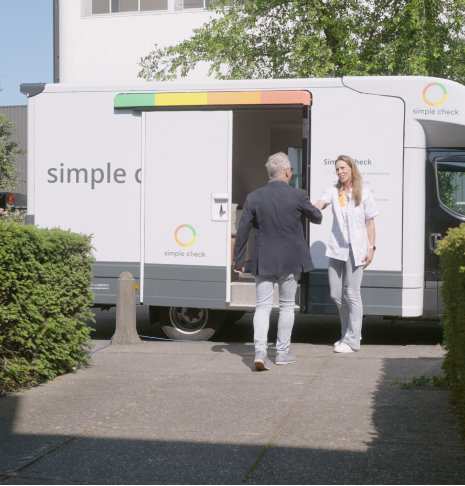
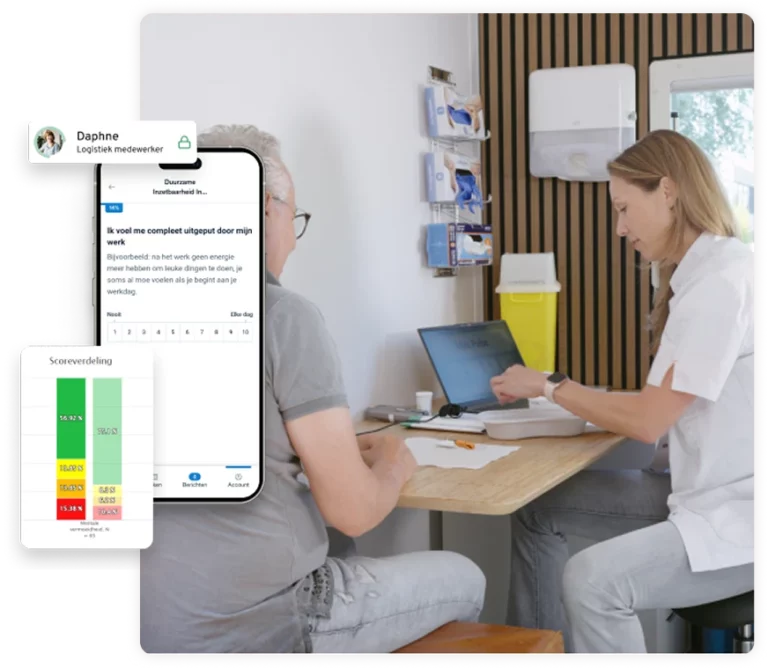
A Preventive Medical Examination (PMO) is required by law, but its true value lies in what you do with the results.…
Our consultants are ready to discover together how to create a healthy, safe and vital work environment in your company.
Request a quote Lisa Meddens
CEO of Simple Check
Lisa Meddens
CEO of Simple Check