





- We get a 9.2 from more than 3,000 reviews
- Digital dashboard with real-time insights
- ISO certified
Menu

Understanding the impact of prevention on absenteeism, job satisfaction and productivity
A manual based on proven methods such as TKI, coaching and mediation.

Learn how to effectively use the Sustainable Employability Index to strengthen your organization.


We prefer to hire younger rather than older workers. Personnel in the 18 - 45 age group are more productive, flexible and versatile. As opposed to older workers who are mostly seen as expensive, burned out and not flexible. But to what extent are these preconceptions true? And what are the consequences for a company if it does not employ an older workforce? The fact that the image of older workers is hardly improving is a serious problem if you ask us. The aging population, rising life expectancy and de-greening will mean that we will have to rely precisely on this group in the coming years. It's time to take a look at the prejudices that get in the way of hiring people over 55.


5-step plan for effective policy, including checklist.
"*" indicates required fields
More than 1,700 companies went before you. It's that simple. Check.
It is true that older employees generally take longer and more frequent sick leave than younger employees. This is because older people are more prone to back, neck, and joint problems, or suffer from cardiovascular disease. The CBS's own research shows that absenteeism due to illness is highest among 55- to 65-year-olds, at 5.8%. However, the CBS also reports that between 2006 and 2015, there was an upward trend in the age at which employees retired .
The average retirement age has increased from 61 to 64. This outcome shows that older people want to work longer, but are sometimes unable to do so due to health issues. If we are not careful, absenteeism among workers over the age of 55 will continue to increase.
No less than 22 percent of 480 European employers are convinced that older employees less productive than younger employees. This is according to a study by the Economist Intelligence Unit. Added to this is the fact that we label employees aged 45 and over as "older employees." As a result, a large group in our labor market is seen as less productive. Too large a group, if you ask us. It is precisely these employees who:
In order to improve the working conditions of the older worker, the so-called relief measures have been drawn up. This means that for employees 55 and older, additional leave days, flexible working hours and task relief should be included in the collective bargaining agreement. It should be clear by now that these perks are not having the right effect. Thanks to these entitlements, employers see their older staff as a group with high (wage) costs.
In addition, employers feel that older workers hinder the adoption of new technology. However, it should be remembered that when older workers retire early, it will greatly affect the quality level of the company. After all, before the new or younger employees have the same knowledge and level of work, we are years away. Therefore, the question arises for us: why aren't employers lining up en masse to hire older workers?
A survey by TNS-NIPO says that at least 69% of European companies do not have a structural approach to reducing the risk of health risks in older people. Generally, HR managers choose to promote staff health through ad hoc projects. This should change in the coming years. The larger the group of older workers in a company, the more need there will be for a structured approach. Simply because this group needs regularity and continuity.
Stress is one of [the main reasons for absenteeism from work. To prevent stress from being perceived as burdensome, employers should pay more attention to the development of its employees. The development of talents and motivations for example, is an important factor in creating and maintaining a work-life balance.
When employees have more self-insight, they are better able to identify what drives them and how to take good care of themselves. In the run-up to 2020, therefore, employers should implement measures that contribute to a positive perception of work. In particular, coaching, career guidance and talent and motivation development will rise in popularity in the coming years.
"If it is clear to an employee what he wants and what he stands for, that can be a strong motivation to do things differently from now on. By discovering what gives you energy (in the short and long term!), if you dare to admit that you are less good at something and if you recognize which activities cost energy, you will be strong and stay more balanced," says Ellen Rentenaar Mediator, Coach and Trainer.
One-third of older employees would like to continue working after the age of 65. This is according to the study 'Is 75 the new 65?' by The Economist. People over the age of 55 would like to continue working longer, provided that the number of hours they work after reaching retirement age can be gradually reduced. "Older employees have enormous mental capital in terms of experience and knowledge," says Tom Kirkwood, head of The Institute for Ageing and Health at Newcastle University.
So why not? Just because employers emphasize flexibility, mental and physical toughness and proficiency with new technologies does not mean that the loyalty and reliability of older workers does not add value to a company. To get the most out of the workforce, employers should stay up to date on who contributes what. Engaging with employees, for example, keeps them informed about employability and makes it clear to both parties what to expect.
If we continue on this path, absenteeism among the over-55s will increase. Health problems will ultimately be the reason why older employees are no longer able to perform their work properly. You will then not only have to look for staff of the same quality, but also for those with the same experience. In other words: prepare for the future and ensure that by 2020 'keeping employees healthy' is in the top three of your HR agenda.
Invest in the health of your workforce so there are no surprises. If you don't address the aging and de-growth issues in your company on a regular and planned basis now, you will be too late. For example, by investing in developing talents and motivations, engaging with employees and emphasizing the benefits of older workers, you will stimulate job happiness. Because no matter what, older personnel are an important part of the labor organization. As an employer, you better be ready for that.
Taking care of older staff, can be one of the focal points, of your sustainable HR policy. Are you an HR professional and would you like to receive more information on increasing the sustainable employability of employees?
Then quickly download our 'Simple Checklist' and start setting up sustainable HR policies!

Download the Simple Checklist for free!
✓ Optimize sustainable employability
✓ Increase engagement and positive work attitude
✓ Increase productivity
✓ Ensure greater job satisfaction
✓ Reduce absenteeism due to illness

As CEO of Simple Check, I am committed to helping organizations and employees work in a vital, healthy, and enjoyable way every day.
Working with Simple Check means clear insight into what is really going on within your organization.
We help companies get a handle on work stress, vitality, health and engagement so that employees stay healthier, more energetic and productive.
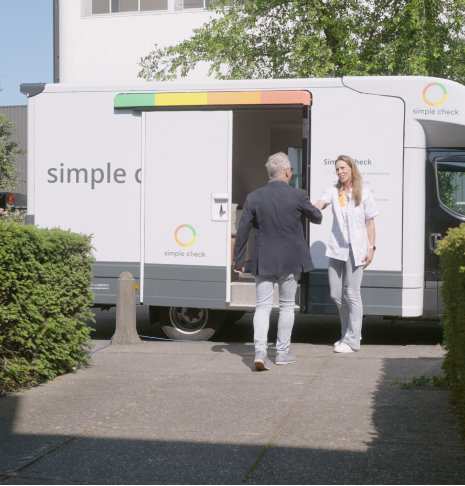

A Preventive Medical Examination (PMO) is required by law, but its true value lies in what you do with the results.…
Our consultants are ready to discover together how to create a healthy, safe and vital work environment in your company.
Request a quote Lisa Meddens
CEO of Simple Check
Lisa Meddens
CEO of Simple Check