



- We get a 9.2 from more than 3,000 reviews
- Digital dashboard with real-time insights
- ISO certified
Menu

Understanding the impact of prevention on absenteeism, job satisfaction and productivity
A manual based on proven methods such as TKI, coaching and mediation.

Learn how to effectively use the Sustainable Employability Index to strengthen your organization.


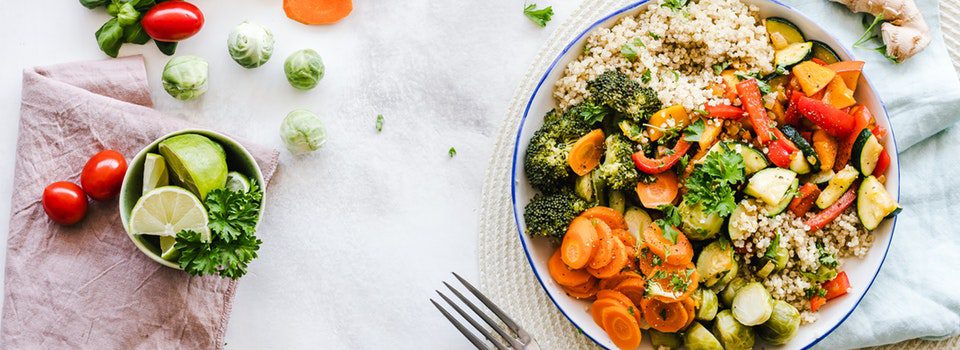
It can hardly have escaped your notice that recently there has been increasing attention to the importance of a more plant-based food supply. Plant-based eating has a positive effect on health, climate and animal welfare. In this blog, you can read about exactly how this works. In addition, we provide tips to make any transition easy, website tips for recipes of simple plant-based dishes and the points of interest that are important if you want to start eating more plant-based.

5-step plan for effective policy, including checklist.
"*" indicates required fields
More than 1,700 companies went before you. It's that simple. Check.
Cutting down or eliminating animal products from your diet can be very healthy, but it doesn't have to be. Whereas vegetarians and vegans used to rely on trying to make their own bean burgers, there is now a very diverse and growing range of substitutes for animal products, such as meat, fish and cheese. For each product there is a lot of difference in additives, such as how much salt, for example. Even junk food now has substitutes, such as the vegan magnum or pizza. And junk food remains junk food. In general, unprocessed food is always the healthiest choice.
The largest dietician organization in the world; The Academy of Nutrition and Dietetic, states that a well-balanced vegetarian or vegan diet is healthy, contains sufficient nutrients and has health benefits in preventing certain diseases. They also state that a plant-based diet is suitable for everyone, at any age and at any stage of life including pregnancy, if you are breastfeeding, children, the elderly and athletes.
By eating less meat and more whole grain cereals, legumes, vegetables, fruits and plant-based meat substitutes, you reduce your risk of cardiovascular disease. The Voedingscentrum does still have unprocessed meat in the disk of five, but also clearly mentions that eating meat is not necessary. If you do eat meat, they advise eating no more than 500 grams of unprocessed meat in the week.
Processed meat (all meats such as sausages and ham, as well as marinated white or red meat) and red meat (from cattle and pigs) are best avoided altogether. Research has shown a clear link between eating these and the risk of certain types of cancer (including colon cancer), type 2 diabetes and having a stroke.
The United Nations Intergovernmental Panel on Climate Change (IPCC) recently published a report on the link between land use and global warming. This report is an analysis of more than 7,000 studies, which were reviewed by 107 experts from 52 countries.
One of the most important conclusions of this study is that both our land use and our food system must be drastically reformed in order to limit the rise in temperature to a relatively safe level.
There are several reasons why animal agriculture has such a big impact on the environment. Meat consumption worldwide has increased tremendously over the past few decades. Thus, to meet the demand, an awful lot of livestock must be raised, and thus the environmental impact has also increased tremendously as a result.
To give a picture of the Netherlands: In 2018, just over 640 million animals were slaughtered. This amounts to about 1.8 million animals per day. These are huge numbers. There are several reasons why keeping so many livestock has harmful effects on the environment:
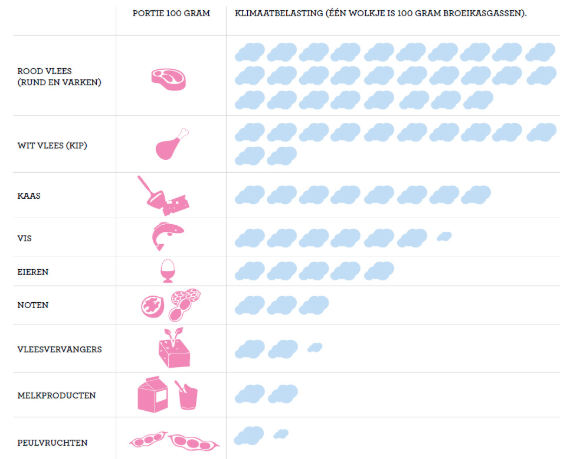
So going plant-based(er) has many benefits, both for your own health and the health of the earth. It is also better for animal welfare if the demand for meat decreases. Have you become motivated and want to start eating more plant-based? Then read on now!
If you want to eat plant-based(er) for the health benefits, it is important to make vegetables the main part of your meals. Fill the rest with whole grains, legumes, nuts, seeds and fresh herbs. If you have a different motivation to get started, it may be helpful to start with 1-to-1 substitutions.
Then simply replace the meat variety with the substitute of the product in question. So you replace minced meat with vegetarian mince, chicken with vegetarian chicken pieces and a regular hamburger with a plant-based burger. Generally, this is a bit more expensive because meat substitutes can be pricey. Although many supermarkets are currently responding to the increasing demand and all now have cheaper alternatives of their own private label. In terms of taste, there is a lot of difference in the different products, so try some things out and find out what products you like!
There are a few things to watch out for when switching to a (more) plant-based diet. Protein, iron, vitamin B1, B2, B12 and calcium are nutrients found in animal products. It is therefore important that you make sure you get these nutrients from somewhere else. You can do this just fine, except for vitamin B12. You will read more about this later. Variety in your diet is important to avoid deficiencies. But of course, this does not specifically apply only to people who eat plant-based foods. By varying your diet a lot, you get many more different nutrients. So the more variety, the healthier this is!
To get enough of these, it is recommended that you choose something from the following list every day:
Calcium is not only found in cow's milk, but you can also get it from other products without any problems. So a plant-based diet need not affect your intake of this. By varying your intake of vegetables, especially green leafy vegetables, and using fortified plant-based milk and other plant-based milk products, you will soon get enough calcium. Choose something from the list below and vary it:
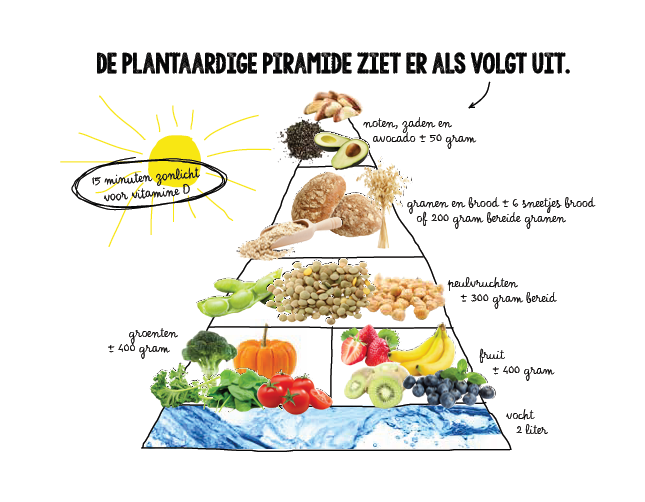
Source image: https://www.lisasteltenpool.nl/hoe-ziet-een-gezond-vegan-dagmenu-eruit/
If you switch to a (more) plant-based diet, it is important that you supplement vitamin B12. This is the only vitamin that you cannot obtain from a plant-based diet.The consequences of a B12 deficiency can be very serious and cause permanent damage. So pay close attention to this!
B12 is produced by bacteria that live in water, on plants, and in your intestines, among other places. Because B12 is only produced at the end of your intestines, it can no longer be absorbed. In addition, we live in such clean environments nowadays that there is virtually no B12 left in our drinking water and plant-based foods.
But this also applies to the water and feed our livestock receive today. For this reason, some animals in the industry are given B12 supplements. Vitamin B12 can be obtained by eating animal products or by taking supplements. If you switch to a (more) plant-based diet, it is important to take B12 supplements. The less animal products you eat, the greater the chance of a deficiency. (Although people who eat meat every day can also become deficient due to absorption problems. So even with eating animal products, there are no guarantees!).
Our comprehensive blood test provides insight into blood levels and some vitamins such as vitamin B12 and Vitamin D.
As a vegan, you don't use animal products at all, including in food. So vegans eat completely plant-based. A good way to start eating (more) plant-based food is to join the Vegan Challenge. This challenge starts October 1. If you participate, you will challenge yourself to eat vegan for 30 days.
You can sign up for this for free and you will then receive newsletters full of information, facts, tips and recipes during those 30 days. The recipes you receive are completely supermarket-friendly, so there is no need to get your groceries from special organic stores, for example. Also, the recipes fit well with an average Dutch diet. Do not expect only healthy recipes, but also recipes for, for example, cakes or other treats. You can subscribe via this link.
Don't want to join the Vegan Challenge, but would like to try some recipes of plant-based dishes? Then take a look around the following websites:
Sources:
https://www.wur.nl/nl/Dossiers/dossier/Vleesconsumptie.htm
https://www.milieucentraal.nl/milieubewust-eten/vlees-vis-of-vega/vlees/
https://www.voordewereldvanmorgen.nl/duurzame-blogs/de-soja-footprint
https://www.greenpeace.org/nl/natuur/428/de-milieu-impact-van-vlees-en-andere-dierlijke-producten/
http://edepot.wur.nl/464128
https://www.voedingscentrum.nl/nl/thema-s/duurzaam-eten/meer-plantaardig-eten.aspx
https://www.ipcc.ch/site/assets/uploads/2019/08/4.-SPM_Approved_Microsite_FINAL.pdf
https://www.ncbi.nlm.nih.gov/pubmed/27886704
https://veganchallenge.nl/het-grote-voedings-abc-calcium-en-waar-je-het-vandaan-haalt/

As CEO of Simple Check, I am committed to helping organizations and employees work in a vital, healthy, and enjoyable way every day.
Working with Simple Check means clear insight into what is really going on within your organization.
We help companies get a handle on work stress, vitality, health and engagement so that employees stay healthier, more energetic and productive.

A Preventive Medical Examination (PMO) is required by law, but its true value lies in what you do with the results.…
Our consultants are ready to discover together how to create a healthy, safe and vital work environment in your company.
Request a quote Lisa Meddens
CEO of Simple Check
Lisa Meddens
CEO of Simple Check