




- We get a 9.2 from more than 3,000 reviews
- Digital dashboard with real-time insights
- ISO certified
Menu

Understanding the impact of prevention on absenteeism, job satisfaction and productivity
A manual based on proven methods such as TKI, coaching and mediation.

Learn how to effectively use the Sustainable Employability Index to strengthen your organization.


Being optimistic does not mean that problems never arise again, but that your attitude toward them is different. You have more influence over them. That's what psychologists call an optimistic attitude. An optimistic attitude makes you suffer less from stress and negative emotions. So even when life gets tough, optimists are more likely to see the benefits: after all, in every obstacle and every failed attempt, there is also an opportunity to learn. Or they experience it as a challenge to deal with it in the best possible way. This increases your mental resilience!


5-step plan for effective policy, including checklist.
"*" indicates required fields
More than 1,700 companies went before you. It's that simple. Check.
"Resilience, optimism, hope and self-confidence help us through a crisis.
As we wrote before, resilience, optimism, hope and self-confidence help us through a crisis. But what exactly do these four traits entail? And how can you develop them further so that they really help you increase your resilience? We started last week with the topic of resilience and are now taking it a step further by focusing on optimism. What is its importance and how can you further develop optimism? Read along with us:
"If you surround yourself with people who have a positive attitude, you will be happier yourself as a result" _David Mezzapelle, Author of Contacious Optimism
According to researcher and author David Mezzapelle, optimism can be learned. As such, he revealed seven simple habits that can help us along the way. We take a quick look at them with you:
Be grateful for the (seemingly) small things in life.Scientific research shows that the activity that makes people happiest is expressing their gratitude. Being grateful for both the big and small things in life is exactly what optimists are good at, says Mezzapelle. The latter seems particularly important: "When you are grateful for the sun rising in the morning or your child smiling, it also makes the big things in life extra special."
Invest time and energy in othersOptimisticpeople always ensure that they can devote a large part of their time and energy to the people around them. "By paying attention to other people's problems, you become more aware of the things that are going well in your own life," says Mezzapelle.
Show interest in the people around you. "A problem shared is a problem halved," as the saying goes. And that turns out to be true. Hearing that other people also experience problems, and that they manage to deal with them well, strengthens our hope for a positive outcome when we ourselves are struggling with problems.
Surround yourself with positive people.When you mainly associate with pessimistic people, it can be extremely draining. Positive people, on the other hand, radiate energy, and that is contagious.
Don't listen to demotivating opinions. "Whatpeople do or say is always a reflection of their own reality, not yours,"says Mezzapelle. Optimistic people therefore manage to ignore the often negative opinions and advice of others. "Don't be discouraged by people who claim you can't achieve your goal," he says. "Ignore their judgment and listen to your own story."
Be forgiving.Although this is often easier said than done, people who can forgive others for their mistakes are generally happier. "The easiest way to be forgiving is to realize that the past is over," says Mezzapelle. Don't let things that happened in the past spoil the present.
Put a smile on your face.It seems so simple, and perhaps it is; smiling creates a positive atmosphere and is contagious. When people smile, they automatically feel happier because small doses of serotonin are released in the brain. This hormone creates a feeling of 'general well-being'. In addition, laughing is also said to benefit our health. A study at the University of Kansas found that by smiling, even when we don't feel happy at all, we can better arm our bodies against the impact of stress.
Of course, you don't always manage to carry out the above tips on a daily basis as a matter of course. Yet you will be amazed to what extent your way of thinking, is a skill you can learn. For that, increasing self-insight is important. Let's continue with finding out what your behavior is in this.
"You yourself have more influence on how you experience situations than you often think,"_ said Ellen Rentenaar, coach, trainer and mediator.
According to "attribution theory," we often look for causes within or outside of ourselves. In "internal" attribution, you tell yourself that you are the one who has influence. In "external" attribution, you place the cause on something or someone else. Together, these two form the first dimension of attribution. For example: you get a good review at work and you feel you deserve it. That's step one. But what is that review worth if you are afraid that you will fall through on the next project. Or that other colleagues might not be so happy with your work at all? This is why attribution theory has two more dimensions: 'Temporary/permanent' and 'specific/global'.
So the trick is to be aware of all these facets. If you translate this to the earlier example of the good assessment, it looks like this: when you feel that it is your own merit (internally), that you are appreciated more often (permanently)and that not only your boss but also your colleagues are happy with your work (globally), then you are probably confident that your efforts are worthwhile. Those who are alert to their attributional style in this way and begin to view situations more positively develop their optimism.
And even if it is the case that you have no or very little influence (external) anyway, there is little hope for improvement (permanent) and even if things are going badly on all fronts (overall), it still makes sense to remain optimistic. In that case, optimism may not be or feel realistic, but it does help you keep motivating yourself and looking for solution to get out of that situation.
The opposite of optimism is pessimism. Pessimism comes from the Latin word pessivum. This means "the worst. A person is usually said to be a pessimist if he or she always expects events to unfold badly. Pessimistic people often blame setbacks on themselves (internally). They have the idea that things will always be this way (permanent) and see it as something that affects all kinds of areas (global).
Optimistic people look for the causes of setbacks to be external ("it's a tough job too"), as temporary ("this may be tough, but when it's finished I'll be glad I did it again") and as something specific ("math may not be my thing, but I'm good at sports").
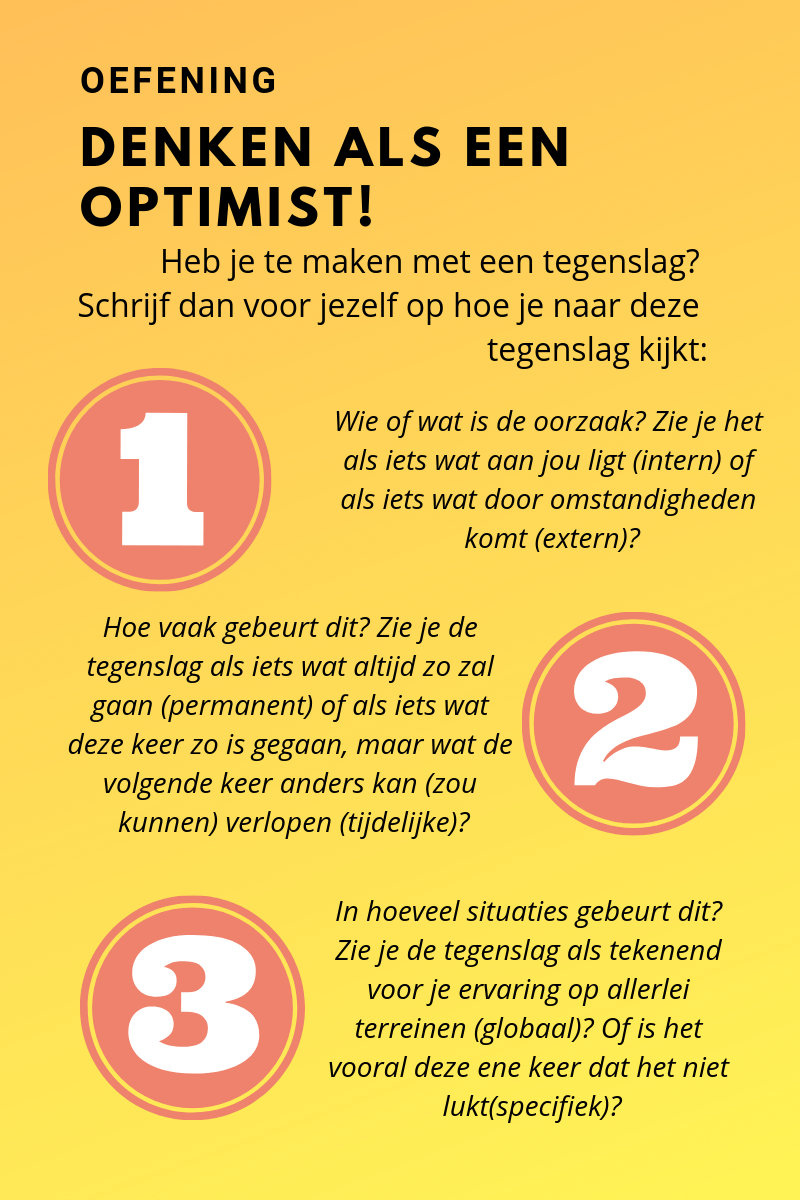
If you find that you are inclined toward the pessimistic explanation (internal, permanent and global), also work out a typical optimistic response to a setback; write down temporary, specific causes outside of yourself.
You can make this approach your own to some extent by consciously practicing it regularly. You do not have to believe the optimistic explanation immediately, as long as you pay attention to it. Then it already has a positive effect, however small it may seem at first. Practice makes perfect! A training or personal coaching might help you with this. Simple Check works closely with several coaches and trainers who specialize in this topic and are eager to get started preventively. Feel free to contact us for more information.

As CEO of Simple Check, I am committed to helping organizations and employees work in a vital, healthy, and enjoyable way every day.
Working with Simple Check means clear insight into what is really going on within your organization.
We help companies get a handle on work stress, vitality, health and engagement so that employees stay healthier, more energetic and productive.

A Preventive Medical Examination (PMO) is required by law, but its true value lies in what you do with the results.…
Our consultants are ready to discover together how to create a healthy, safe and vital work environment in your company.
Request a quote Lisa Meddens
CEO of Simple Check
Lisa Meddens
CEO of Simple Check