
Effective smoking policy at work, 4 reasons why!

As an organization, you are legally obliged to take a number of measures to reduce the nuisance of smoking. But in addition to this legal obligation, you can also opt for a smoking policy to support sustainable employability and increase vitality.

Why a smoking policy?

  1. Focus on the health of all colleagues
    In addition to the well-known risks of smoking, there is growing awareness of the harm caused by secondhand smoke. This can be incorporated into a general policy in which you choose to consciously support a healthy lifestyle for all employees. Focus on smoking and secondhand smoke as part of a sustainable employability policy.
  2. Sustainable employability has a positive impact on costs
    Employee smoking incurs various types of costs for a company. These include: a.Costs due to smoke breaks. An employee who smokes and is away from their workplace for an average of four ten-minute breaks per day (including walking to and from the smoking area) spends 3 hours and 20 minutes per week (approximately 150 hours per year) smoking (based on 45 working weeks). At an hourly rate of €31.10, this represents a loss of €4,665 per year per smoking employee. (Health and care in figures, CBS, 2007) b.Costs due to absenteeism. With an average absenteeism rate across all employees of 4.2 percent in the Netherlands in 2007, heavy smokers are absent 5.8 percent of the time, moderate smokers 3.8 percent, ex-smokers 3.4 percent, and non-smokers 2.4 percent (Health and Care in Figures, CBS, 2007)c. Costs of smoke-free areas and ventilation. Ventilation standards are higher in areas where smoking is permitted. The requirements for air taken in from outside are two to three times higher and the filters must be cleaned and replaced more often when tobacco smoke is ventilated, which increases costs (Action on Smoking and Health, Smoking in the workplace costs employers money. ASH Washington DC 20006, (202)
  3. Monitoring the working atmosphere
    Clear agreements are in the interests of both non-smokers and smokers. A survey of 150,000 employees in the Netherlands shows that 42 percent of non-smokers who are bothered by passive smoking at work do not discuss this with their smoking colleagues in order to avoid conflict (European Network for Smoking Prevention (2001). Smoke-free workplaces. Improving the health and well-being of people at work. Brussels: European Network for Smoking Prevention). This increases the likelihood of dissatisfaction and a lack of motivation.
  4. The majority of Dutch people really want to contribute to a smoke-free generation
    Research shows that a majority of Dutch people want to work towards creating smoke-free places for young people. This is evident from a study conducted by Kantar Public on behalf of KWF Kankerbestrijding (Dutch Cancer Society). More and more people are becoming convinced of this. In the Netherlands, more and more places within organizations, such as schools, sports clubs, municipalities, and playground associations, are being made smoke-free. The initiative comes not only from professionals, but also from concerned colleagues, parents, and other stakeholders.As a company, you can respond to this and set an example that many people apparently need.

Plan of action

What steps can you take to reduce smoking in your organization? It is important to introduce this step by step to avoid (possible) resistance and increase support. You can think of:

  1. Inform everyone why is there so much focus on smoking? Organize information sessions on the risks of smoking and especially what the benefits of quitting are, focusing on health.
  2. Continue to provide regular, inspiring information about the challenges people face and the many benefits of quitting smoking. Simple Check has a number of interesting, informative, and inspiring articles that you can use for this purpose, without any obligation. Please feel free to contact us for more information.
  3. Internal structure: put together a motivated and enthusiastic colleague or group who will be responsible for implementing the new policy. And who above all drive from a positive approach.
  4. Making rules: formulate principles for the new smoking policy and communicate them in a clear and positive way.
  5. Implement: take time so smokers can prepare.
  6. Evaluate: what is the situation after one year? Consider a lung test from Simple Check.
  7. Secure long-term policies. Stay alert and maintain a positive approach. Even when it appears that not everyone can make it to quit.

Support and promotion

Would you like support in developing an effective smoking policy that suits your organization? Please contact us. We are happy to help you. You can also let your employees know about Stoptober, an initiative of the Dutch Cancer Society, the Dutch Heart Foundation, the Dutch Lung Foundation (formerly the Asthma Foundation), the Ministry of Health, Welfare and Sport, the Trimbos Institute, GGD GHOR Netherlands, and the Smoke-Free Netherlands Alliance.

Stoptober is 28 days of not smoking in October; quitting smoking together for 28 days increases the chance of sticking with it by a factor of five! With its joint approach, Stoptober offers an excellent opportunity to encourage people to quit smoking in your company or organization. This not only increases the chance of success, but also strengthens the bond between your employees.

Encourage your employees to participate in Stoptober. You can order promotional materials for your company on this page. The more employees who participate, the healthier your company will be! They can register on the website stoptober.nl starting September 8 and take advantage of all the free support Stoptober has to offer, such as the Stoptober app, the Stoptober magazine, and the Facebook community.

Source:
https://www.trimbos.nl

Active throughout the Benelux

PMO. Just on location.

Working with Simple Check means clear insight into what is really going on within your organization.

We help companies get a handle on work stress, vitality, health and engagement so that employees stay healthier, more energetic and productive.

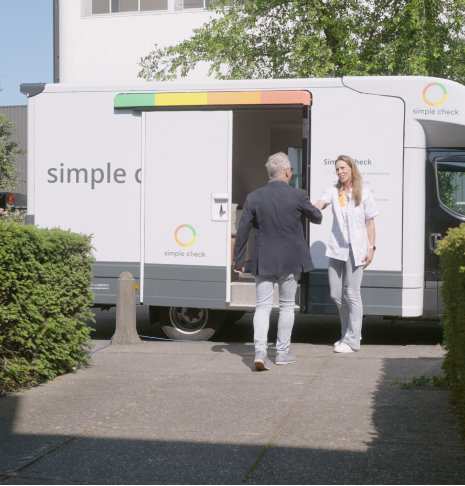
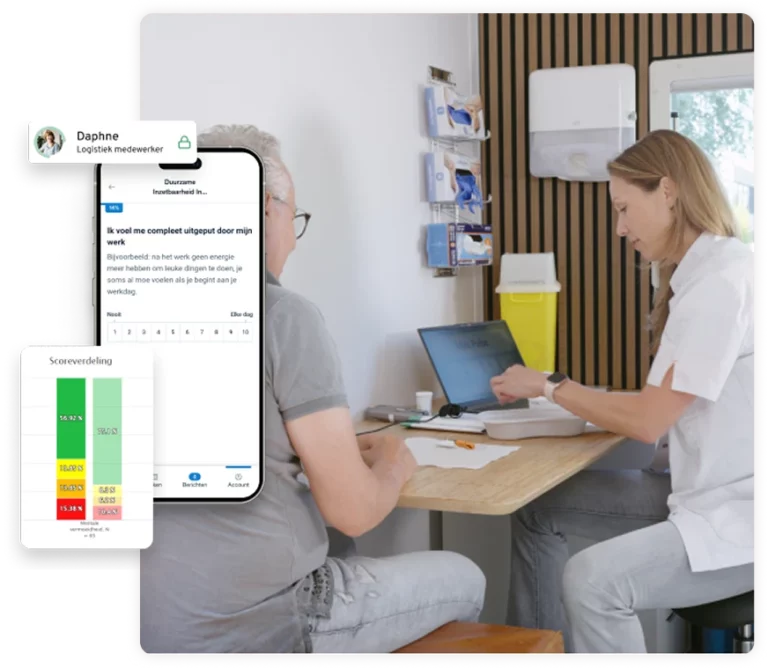
Preventive medical examination (PME) Employee walks to Simplecheck bus

Moving together toward a healthy future

Our consultants are ready to discover together how to create a healthy, safe and vital work environment in your company.

Request a quote

That's why Simple Check

  • PMO at your location
  • High participation, low barriers
  • Guidance on DI policy
Lisa Meddens CEO of Simple Check